
Maya Resurrection
This article continues from section 4.16. It contains more details about the Copán museum.

This article continues from section 4.16. It contains more details about the Copán museum.
This article continues from section 4.17. It provides more details about the ruins and their modern day culture, dwellings, and Copán House of Lords.
This article continues from section 4.18. It provides more details on the House of Lords.
This article outlined some excerpts of writing by those who walked the Trail of Tears through Arkansas as well as a description of leader Jesse Bushyhead. A sketch of Bushyhead is in the center of this page.
This article is the next page of the previous entry in section 4.19. It proceeds to outline the illness, life, and death that occurred on the Trail of Tears. This section also has a box in which Cherokee facts are listed regarding their possessions, education, …
This obituary belongs to Walter Richard West and provides the day he was born, the day he died, and a small description of his funeral, death, early life, and accomplishments.
Pictured is a Native American singing in what seems to be traditional dress including a headress; photo is blurry.
This is a poem by Petey Giroux.
This brochure advertises the production of several attractions including an outdoor drama and tours.
This brochure advertises the production of the Trail of Tears drama as well as attractions such as the villages and Cherokee National Museum.
This article begins to outlines details about how 25 Cheyenne people were gunned down and killed and how they could not find peace even in death due to them being dug up and shipped to Washington.
This article is continued from section 5.3. It outlines the story of Chief Dull Knife, a Cheyenne chief, and the distribution of the Indian remains to the Smithsonian and other museums.
This article outlines the occurence of a new law that allows proper reburials for remains discovered in unmarked graves.
This clipping shows a picture of tribal members at the freshly dug graves to bury the remains of the Cheyenne that were gunned down and killed as well as a caption describing the photo.
This article outlines the discovery of a city called El Pital, discovered by S. Jeffrey K. Wilkerson. Pictured is a seaport on Mexico's Gulf Coast.
This article outlines the celebration of the 500 years of resistance the Native Americans have faced.
This article outlines the start of journalism by Native Americans, specifically Cherokee.
This brochure shows pictures, text, and symbols relating to Christianity with an address to "Bible Baptist Shepherd Rod and Rose Vincent".
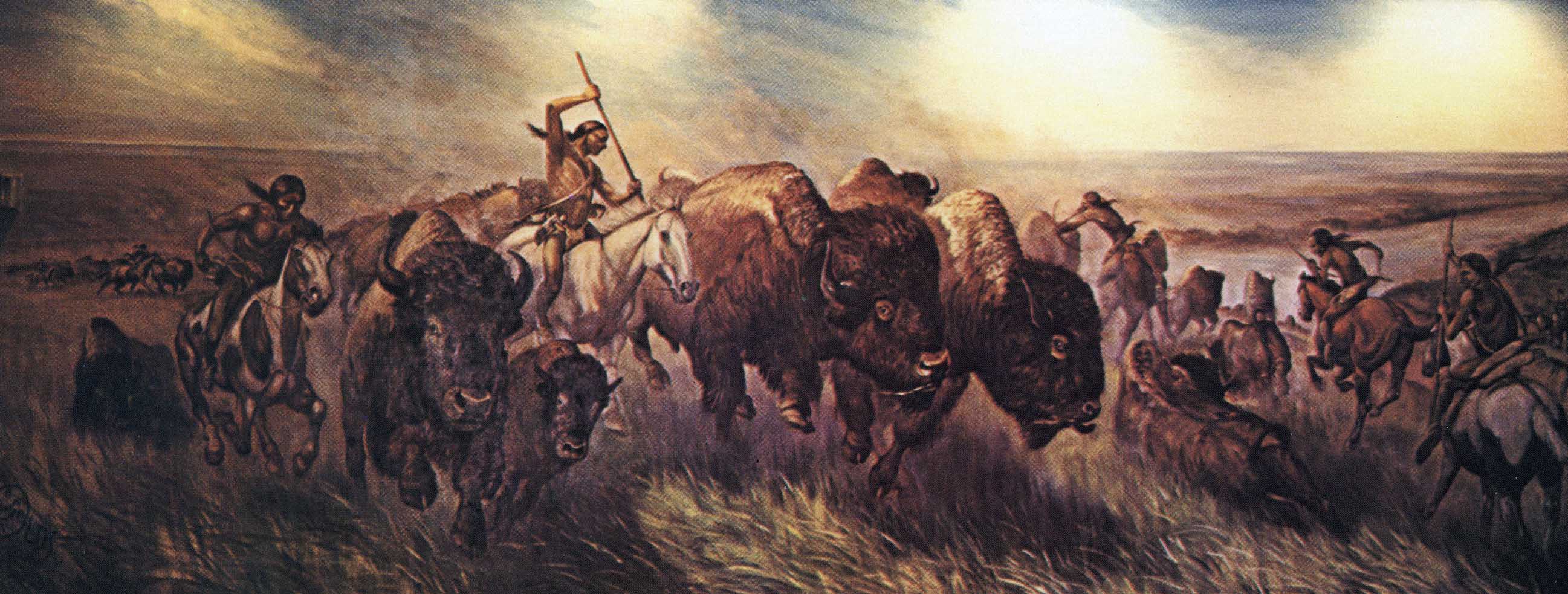
Pictured are three buffalo running through a field with two birds above them and the sun appears to be setting. No text.
This article outlines the importance of buffalo jumps and highlights details of the most famous one, Head-Smashed-In.
This article outlines how Oklahoma native, Studi, played a role in 'Last of the Mohicans'. He also predicts the future of the film industry for Native Americans and his acting career is summarized in this article.
We have four copies of this article. This article contains details about R. G. Harper, a farm hand, who claims he is the face that is on the Buffalo-Indian nickel.
This article outlines protests in regard to using Indians names or symbols for sports or other things.
This clipping shows a picture of Plains Indians at Fort Marion.
This clipping shows a picture of Justin Douglas Muskrat, a 6 year old who placed third in a Pow Wow on October 3rd.

Advanced search techniques for better results
Soccer Queens - Finds Soccer OR Queens (default)Soccer AND Queens - Must contain both words"Soccer Queens" - Exact phrase match (use quotes)+Soccer -Queens - Has Soccer, excludes QueensEnable the "Use Regex" checkbox for pattern-based searches:
^Smith - Names starting with "Smith"Smith$ - Names ending with "Smith"John|Jane - Finds either "John" or "Jane"💡 Tip: Start with simple searches. Use boolean operators for precise results, regex for advanced pattern matching.
Requesting copy for: